Kalo lagi bahas soal tempat nonton bola sambil pasang taruhan, pasti nama 1xBet sering banget muncul di tongkrongan. Gak heran sih, soalnya 1xBet Indonesia punya fitur streaming yang lumayan enteng buat koneksi internet di sini. Banyak user ngerasa kalo fitur live streaming mereka ini salah satu yang paling stabil dibanding kompetitor lain yang sering buffering.
Selain soal stabil, pilihan pertandingannya juga beneran banyak banget. Mulai dari liga gede kayak Premier League, sampe liga-liga kecil di negara antah berantah pun ada. Buat kalian yang suka banget mantengin stats sambil nonton, antarmuka mereka cukup ramah di mata dan gampang dipahamin buat pemula yang baru mau coba-coba.
Membandingkan 1xBet dengan Platform Streaming Lainnya
Banyak yang nanya, apa sih bedanya sama platform lain kayak Vidio atau layanan streaming resmi? Jujur aja, bedanya itu di integrasi sama bursa taruhan. Kalo pake aplikasi official, ya kita cuma nonton aja, tapi di 1xBet kita bisa langsung pasang prediksi secara real-time pas pertandingannya lagi jalan.
Tentu aja, ada kelebihan dan kekurangannya masing-masing. Di bawah ini ada tabel perbandingan ringkas gites-eldamar.com biar kalian gak bingung milihnya:
Fitur
1xBet Live
Platform TV Biasa
Streaming
Gratis (dengan syarat)
Berbayar/Langganan
Taruhan
Langsung di layar
Tidak ada
Pilihan Liga
Sangat Luas
Terbatas Liga Resmi
Kualitas Visual dan Audio Saat Nonton Live
Soal gambar, ya jangan dibandingin sama Netflix atau kualitas 4K bioskop lah ya. Tapi buat kebutuhan streaming pertandingan, resolusinya udah cukup banget buat ngeliat pergerakan bola dengan jelas. Audio-nya juga sync, jadi gak ada tuh kejadian suara komentator duluan daripada gambar bolanya.
Satu hal yang perlu diperhatiin, kualitas streaming ini sangat bergantung sama provider internet kalian masing-masing. Kalo lagi hujan atau sinyal lagi down, kadang resolusinya turun otomatis biar gak putus-putus. Ini fitur yang pinter sih, soalnya kita jadi gak ketinggalan momen gol gara-gara buffering lama banget.
Cara Mengakses Fitur Streaming dengan Mudah
Buat yang bingung gimana cara bukanya, gampang kok. Pertama, pastiin kalian udah punya akun yang aktif di sana. Kalo belum, ya daftar dulu terus deposit dikit sebagai syarat buat akses fitur live streamingnya. Ini standar sih di banyak tempat, bukan cuma di 1xBet doang.
Setelah login, kalian tinggal cari ikon “Live” di menu utama. Nanti bakal muncul daftar pertandingan yang lagi berlangsung. Biasanya yang ada ikon TV kecil itu tandanya bisa ditonton langsung. Klik aja ikonnya, terus layarnya bakal muncul di sisi kanan atau atas tergantung perangkat kalian.
Apakah Aman Menggunakan Layanan Ini?
Banyak yang ragu soal keamanan data pribadi pas pake aplikasi beginian. Selama kalian download aplikasinya dari link resmi atau mirror yang terpercaya, harusnya aman-aman aja sih. Jangan asal klik link sembarangan dari grup telegram gak jelas yang ngasih janji manis bonus gede.
Saran saya, selalu aktifin sistem keamanan 2FA (Two-Factor Authentication) di akun kalian. Ini ngebantu banget biar akun gak gampang dibajak orang lain. Pokoknya, jaga privasi itu nomer satu, apalagi kalo kita main di situs luar kayak gini biar hati tenang pas lagi asik nonton bola.
Pilihan Liga yang Tersedia di 1xBet
Kalo soal pilihan liga, gak usah diraguin lagi deh. Berikut daftar beberapa liga populer yang sering banget ada di jadwal live streaming mereka:
Liga Premier Inggris (EPL)
La Liga Spanyol
Serie A Italia
Bundesliga Jerman
Liga Champions Eropa
Berbagai liga lokal Asia
Tips Biar Streaming Gak Patah-patah
Biar streaming-nya lancar jaya, saya punya beberapa tips receh yang bisa dicoba. Pertama, pake koneksi Wi-Fi yang stabil daripada pake data seluler yang kadang wishesandgifts.com suka berubah-ubah sinyalnya. Kedua, tutup semua aplikasi background yang makan bandwidth banyak, kayak download-an atau update aplikasi otomatis.
Kalo tetep patah-patah, coba setting resolusinya ke mode yang lebih rendah. Kadang kita gak butuh kualitas super jernih kok, yang penting pergerakan bolanya keliatan dan kita bisa tau siapa yang lagi pegang bola. Jadi, gak perlu maksain resolusi tinggi kalo jaringan di rumah lagi bapuk.
Kesimpulan: Layakkah untuk Digunakan?
Secara keseluruhan, menurut saya 1xBet shrishtifms.com Indonesia Live — Streaming Pertandingan Langsung adalah salah satu opsi terbaik buat para pecinta olahraga yang pengen sensasi beda. Gabungan antara nonton gratisan dan kemudahan pasang taruhan dalam satu layar itu emang juara banget buat nambah keseruan nonton bareng temen.
Meski ada beberapa hal yang perlu diperhatiin soal jaringan dan keamanan, fitur ini tetep worth it banget. Asal pinter-pinter atur strategi dan gak kebablasan, kalian bakal dapet pengalaman hiburan yang maksimal. Selamat mencoba dan semoga tim jagoan kalian menang terus pas lagi streaming!
You get a notification that your Google Business Profile has been suspended and before you can even start panicking, the first question that pops up : “is this bad or really bad?”
To be honest, the answer is not all that clear-cut. Whether this is the end of the world or just a minor blip depends entirely on the type of suspension you’ve got. Google throws two types of suspensions at you – they sound identical, both show up as “suspended” but they require completely different approaches if you want to get back on track. And if you get it wrong you can end up spinning your wheels for weeks doing things that are completely wrong and making things a whole lot worse.
Here’s the explanation in this guide : we’ll break down exactly what each type means, what they look like, what causes them, and the right next steps to take in 2026, because, let’s be honest, figuring this stuff out can be a real challenge.
First, the Quick Answer
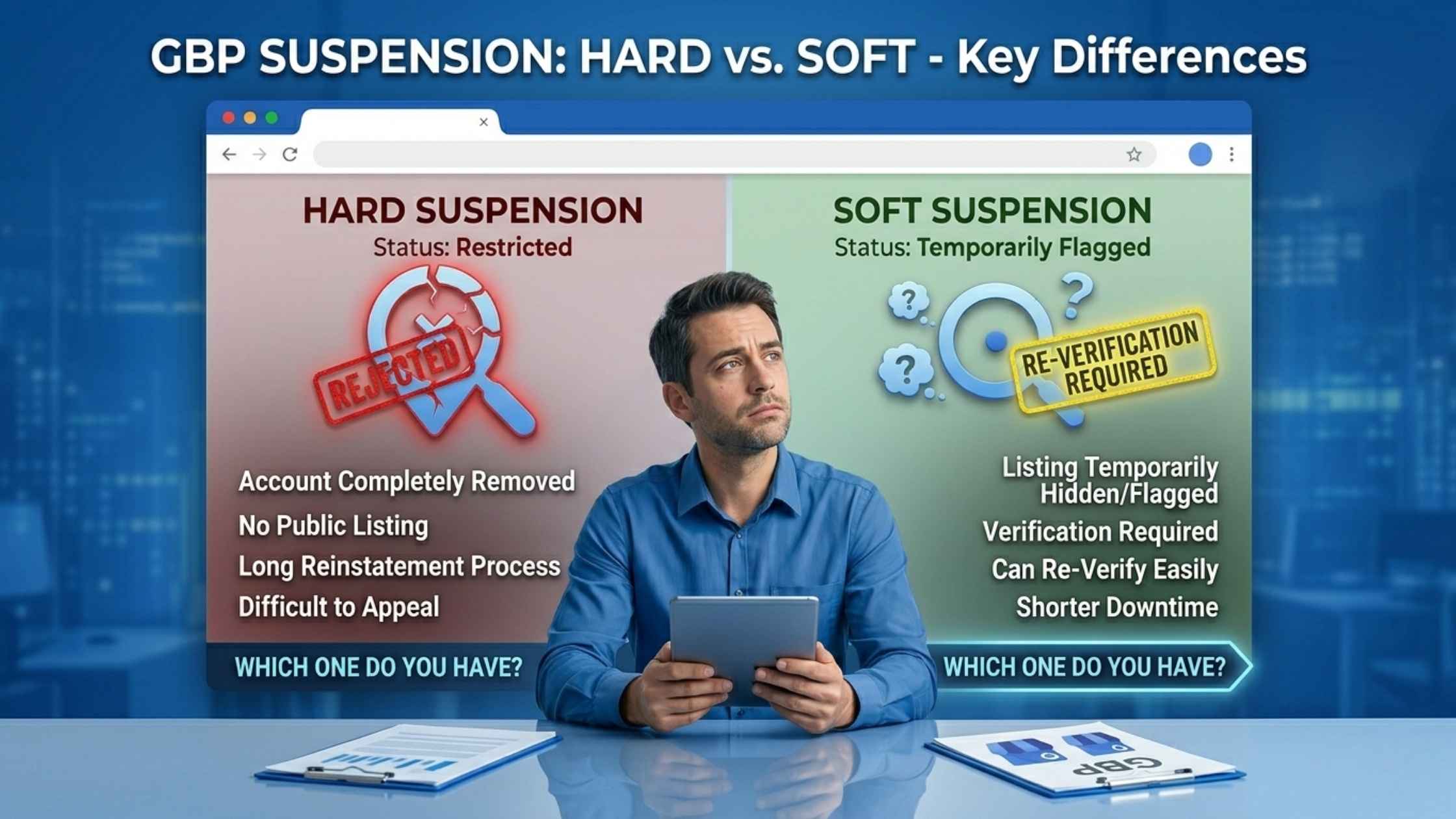
A soft suspension is a right pain in the neck. Your listing’s still visible to the world on Google Maps and Search but you’ve lost all control over it. On the other hand, a hard suspension is much worse – your listing just doesn’t exist for Google at all – no Maps pin, no Search result, nothing.
Same word – two very different headaches. Let’s get into the nitty gritty of both.
What Is a Soft Suspension?
When you get a soft suspension, don’t worry (just yet!) : your listing stays live out there on Maps and Search, so customers can still find you, see your reviews, phone number, directions – the whole shebang. From out there in the world, everything seems normal.
But then you go to log into your Google Business Profile and – Oh no! – you see a big red message that says you’re suspended or unverified. You’re cut off from all the controls. No replying to reviews, posting updates, changing business hours, nothing at all. Your listing just runs on autopilot with whatever was on it when the suspension started.
There’s something sneaky about soft suspensions though – many business owners don’t even notice they’ve been suspended. After all, the listing’s still visible out there – and you might not even know you’ve been suspended for weeks or months on end. It’s only when you try to log in and update something, or see a negative review just sitting there without you being able to respond.
TheGrowwers – one of the best places to look if you’re tracking GBP suspensions – says soft suspensions usually don’t affect your local SEO rankings at all – but that doesn’t mean you can just ignore it.
If you don’t get the underlying issue sorted out, a soft suspension can turn into a much worse hard suspension next time Google does an audit. Treat it as a warning that you need to get on top of – right now.
What does it look like in your dashboard?
When you log in, you get a big red banner saying something like ” profile is suspended”, “profile is unverified” or “we’re restricting access”. The listing still shows up on Maps when people search for you – but on the public side, you find a “Claim this business” link. As if to say nobody’s in charge of managing the listing.
What Is a Hard Suspension?
A hard suspension on Google is a whole different ball game – and one that’s far more serious. Google’s decided to not just demote your listing a bit, but basically wipe it from the face of the earth. Your business vanishes entirely from Google Maps and Google Search. Anyone searching for your business by name can’t find you. Your Maps pin disappears – no more directions to your place. Phone calls and other business stop coming – you basically have no local visibility any more.
There’s no gentle slope of decline here. It’s all gone instantaneously. You’re dropped off the map overnight.
Search Engine Journal notes that hard suspensions happen when Google figures your business doesn’t qualify for a listing or is doing something that breaks the rules. That’s a pretty key distinction : with a soft suspension, Google still thinks your business is legit and belongs on Maps. But with a hard suspension, Google has made up its mind that the listing itself needs to be yanked.
And to make matters worse, recovering from a hard suspension is going to be a real challenge. You can’t just go in and start the whole verification process over again . You need to go through Google’s official reinstatement process, which means getting documentation together that proves your business is real and above board, then (if you’re lucky) getting past the automated review queue and in front of a human reviewer.
One crucial thing to remember in 2026 : once you open up that evidence upload form, you’ve got 60 minutes to get all your files up there. If that window closes before you’re done, your evidence won’t stick and your appeal will probably get rejected – so get all your ducks in a row before you even start the process.
Free Audit
GBP Suspended? We Fix It. No Upfront Payment.
98% success rate · 2 to 7 days · Pay only after your listing is live
Before you start trying to sort things out, first make sure you know what you’re dealing with. Here’s a simple 3-step check you can do right off the bat.
Step 1. Try opening a new incognito window in your browser and typing in your business name on Google Maps – see if your business pops up. If customers can still see you, then you’re likely dealing with a ‘soft suspension’. But if nothing shows up at all – well, it’s probably a hard suspension.
Step 2. Get logged into your Google Business Profile dashboard at business.google.com to take a look. If you see a message saying your profile is suspended or unverified but it’s still visible to the public, then that’s a soft suspension. On the other hand, if your profile isn’t showing up in the dashboard at all, or it’s got a big “hard suspended” notice on it, it’s a hard suspension all right.
Step 3. Think about whether you’re still getting calls and directions from customers via Google Maps. If things have completely died down and you’re no longer getting any business from Maps – then a hard suspension is probably your problem.
Soft suspensions are the result of Google throwing up its hands and saying ‘ hold on a minute ‘ when it encounters some inconsistency or red flag with one of your listings – but it’s not quite bad enough to warrant a full removal. The most common causes are:
Making Big Changes to Your Core Profile. Changing your business name, address or phone number is enough to trigger an auto-verification re-req and if Google can’t get that sorted out right away, it’ll slap on a soft suspension until you can prove that it’s all legit.
Your Business Info is All Over The Place. Google is constantly checking your business details against other listings like Yelp, Facebook, and Bing Places to make sure everything is consistent. But if your business name, address or phone number appears to be vastly different across multiple platforms – yeah, that’s a problem. Even tiny differences like ‘Street’ vs ‘St’ have been enough to trigger a suspension in the past.
Someone’s Complained. Any Maps user can suggest an edit to your listing or flag it as incorrect. If that happens enough times – or if it comes from someone Google trusts – off goes that soft suspension pending review. And yeah, some of your competitors might just be using this tactic to take you down a peg in a competitive market.
Something Else Went Wrong with Your Google Account. If the person in charge of your profile gets flagged for something somewhere else across Google – even if it’s not related to your business – that can have a knock on effect and trigger a soft suspension on all linked Business Profiles.
The one good thing about soft suspensions is that Google still thinks your business is the real deal. It’s a ‘you’re good, but something’s gone wrong’ situation, not a ‘who are you and what makes you think you exist’ situation – so provided you can get to the bottom of what went wrong and make it right before asking Google to reinstate you, recovering from a soft suspension shouldn’t be too bad.
What Leads to Hard Suspensions?
Hard suspensions are rarely ever handed out – they’re usually a serious warning that your business has crossed a line somewhere. According to Google’s own rules on business representation, profiles that break the fundamental guidelines around a business being genuine, having an authentic address and not engaging in deceptive practices, are simply yanked.
The most common reasons we’re seeing for hard suspensions in 2026 are:
Virtual office or dodgy address. Try using a coworking space or UPS store as your business address, and it’s basically a guaranteed suspension. Google has developed systems to compare addresses with known virtual office locations and flags them pretty much instantly.
Keyword stuffing in the business name. Slapping as many search terms into your business name (think Best Plumber Chicago for example) gets you a straight-up hard suspension from Google. It’s plain as day.
Having multiple listings for the same spot. If you’ve created more than one Google Business Profile for the same location – or even the same business – then you’re basically trying to pull a fast one on the algorithm. Yep, a hard suspension is the result every single time.
Working in a high-spam category. If your business is a locksmith, garage door company, moving company or home services contractor, you’re basically on Google’s radar for getting shut down. These industries get exploited left right and centre by bad actors, so if you are a legit business operating in one of these spaces, you’re going to get hard suspended a lot more often.
Failed verifications piling up. If you keep getting verification postcards, phone calls or even video checks sent to your business address but you can’t seem to get it sorted, Google starts to get suspicious. And if you keep getting verification attempts wrong, that can escalate to a full-on hard suspension.
The Google account managing your profile gets suspended. If the Google account that’s linked to your Business Profile gets suspended for whatever reason – even if it’s got nothing to do with your business – then that Business Profile will get yanked instantly.
The Difference Side by Side
Soft Suspension
Hard Suspension
Listing visible to customers
Yes
No
Appears on Google Maps
Yes
No
Appears in Google Search
Usually yes
No
You can manage the profile
No
No
Reviews still showing publicly
Yes
No
Local rankings affected
Minimal
Completely gone
Recovery complexity
Moderate
High
Main issue
Management access
Listing eligibility
Typical recovery time (DIY)
2 to 4 weeks
4 to 8 weeks
Typical recovery time (professional)
3 to 7 days
2 to 7 days
Free Audit
GBP Suspended? We Fix It. No Upfront Payment.
98% success rate · 2 to 7 days · Pay only after your listing is live
Research has been clear on this – a soft suspension doesn’t appear to have a significant impact on local search engine rankings. Your listing is still going to show up in searches and drive calls and leads while it’s still out of commission. But a hard suspension, on the other hand, completely removes your listing from results…although your rankings will usually bounce back once you’ve got your profile reinstated.
However, a soft suspension isn’t a totally free pass. Being unable to add new updates, respond to bad reviews or correct any mistakes that might be on your profile means your profile is going to start looking a bit stale. A listing with a bunch of unanswered negative reviews and no new activity paints a picture that will erode your rankings over time. Don’t put it off until its too late – get on top of it before it starts affecting your search visibility.
Can a Soft Suspension Turn Into a Hard Suspension?
Yes, this is something that catches a lot of business owners by surprise. If you don’t get to the root of the problem, a soft suspension can turn into a permanent hard suspension at the next opportunity for Google to review.
One of the biggest mistakes is creating a duplicate listing while you’re still suspended, or making changes to the profile that break the rules while you’re in the process of being reviewed. Creating a new listing while your original one is still suspended is a really common way to turn a soft suspension into a hard one.
It may not look like a big deal, but a soft suspension is not something to just leave sitting there – take action on it ASAP.
What to Do Next – Depending on What You’re Dealing With
If you’ve got a soft suspension:
Stop messing around with your profile right away – every change you make is logged and reviewed, and making any more changes can just make things worse or delay the review process even further. Go through all the directories where your business is listed and make sure your NAP details are consistent. Figure out what went wrong in the first place and fix it – then try to get your profile reinstated using Google’s official appeals process with proof that your business really does operate at the listed address.
If you’re not confident about the process, or if you’ve already had a rejection, we can do a free case audit and walk you through exactly what’s gone wrong and what you need to fix before you resubmit.
If you’ve got a hard suspension:
Don’t even think about creating a new listing – this is possibly the most common mistake business owners make when they get hit with a hard suspension, and it usually just ends up getting both the old and new listings removed for good. Don’t try to file a generic appeal without doing the legwork to find the root cause first, and make sure you’ve got all the right documentation ready to go. Your business license, utility bills, storefront photos and lease documents all need to match up exactly with your Google profile – even a tiny mistake like missing a suite number can be enough to get your appeal knocked back.
If you’ve already had one or two appeals rejected, the standard public form is unlikely to do the trick. You’re going to need to escalate it to a real human reviewer. We’ve got a hard suspension reinstatement service that will handle the whole process for you, from manual escalation to getting everything sorted out via our agency channel – and you won’t pay a thing until your listing is fully restored.
Will You Lose Your Google Reviews?
For soft suspensions, your reviews are safe. They remain attached to the profile and visible to the public throughout the suspension period. They come back fully intact after reinstatement.
For hard suspensions, the answer depends on how the reinstatement is handled. In most cases reviews are preserved and return when the listing is reinstated, provided the profile is reinstated with the same CID number it had before. The risk of permanent review loss increases if you create a new listing during the suspension, or if Google assigns a new profile ID during reinstatement. This is one of the strongest reasons to avoid DIY attempts that might result in a fresh listing rather than a proper reinstatement of the original.
Free Audit
GBP Suspended? We Fix It. No Upfront Payment.
98% success rate · 2 to 7 days · Pay only after your listing is live
Knowing which type of suspension you have is not just background information. It determines your entire recovery approach. Getting it wrong means under-reacting to something urgent, or over-complicating a situation that could have been handled simply.
Soft suspension: your business still exists on Google and you need to fix what triggered the suspension and regain management access. Hard suspension: your listing has been removed and you need to prove clearly that it deserves to come back.
Both are fixable. Both require addressing the root cause before filing anything with Google. Both are significantly more likely to succeed with proper documentation and the right submission channel.
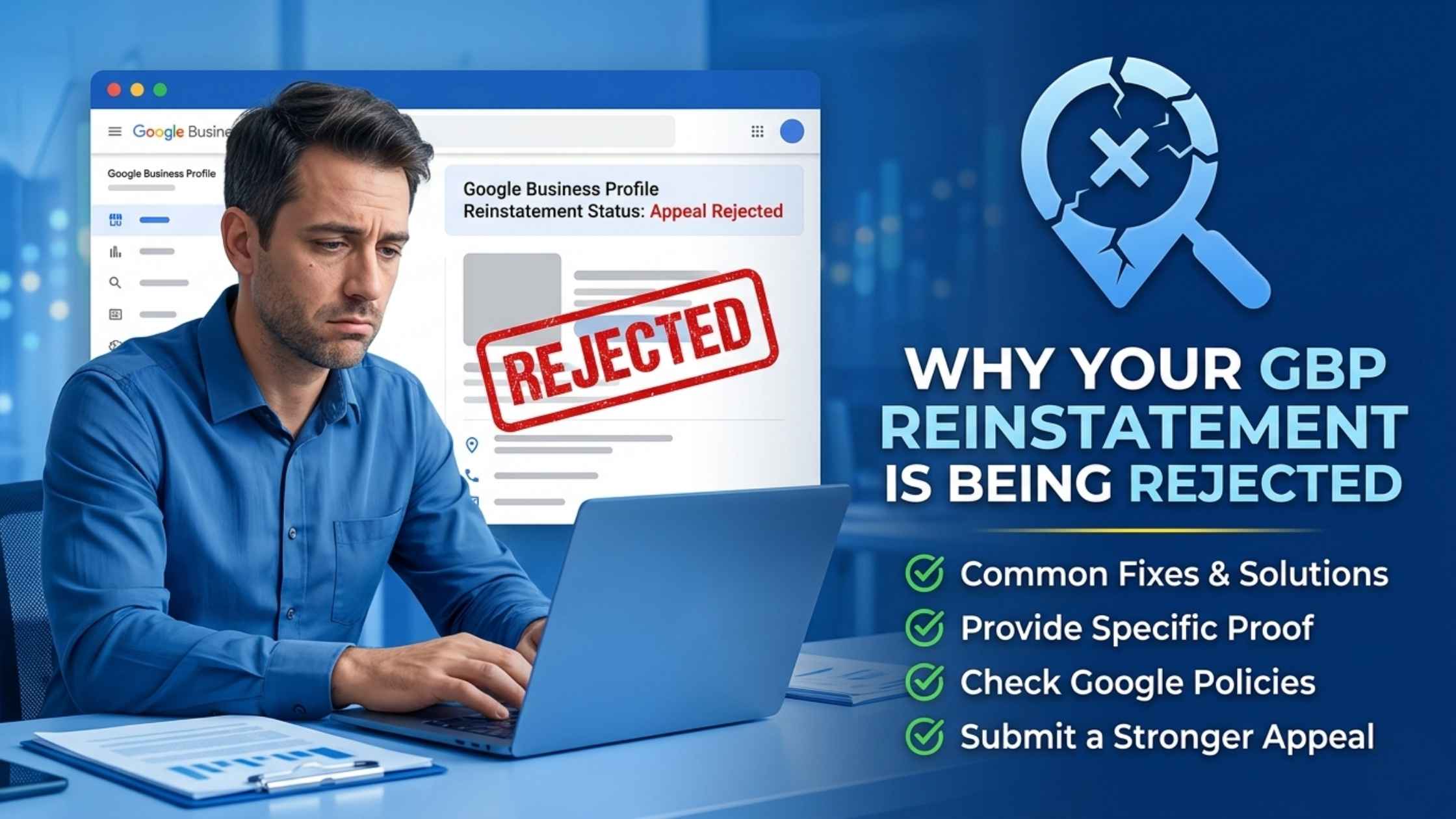
Dealing with a suspended Google Business Profile is frustrating enough, but getting your appeal rejected with no explanation is a whole different game. And if this has happened to you more than once, you’re probably left scratching your head wondering what you’re doing wrong.
The reality is that most GBP reinstatement appeals fail not because businesses are doing anything wrong, but because of a few easily avoidable mistakes when submitting the appeal. Google doesn’t give you any feedback on what went wrong, they just reject you and leave you to figure it out for yourself.
This article is here to break down exactly why appeals get rejected and what you can change right away before you submit another appeal.
First, Understand What Google Is Really Looking For
When you send a reinstatement appeal, it doesn’t get read by a human reviewer. More often than not, it goes through an automated system first. This system is looking for specific signs that your business is on the up and up, operating from the address you claim, and if playing by Google’s Business Profile rules.
If those signs are weak, missing, or contradict what Google already has on file about your listing, the appeal gets rejected automagically before a human even gets a look in.
This is why sending in the same appeal twice doesn’t work, you’re still sending the same weak signals and getting the same automated rejection.
The Most Common Reasons GBP Appeals Get Rejected
1. You Haven’t Sorted Out The Root Cause Before Submitting
This is the number one reason appeals fail, and it’s also the least obvious one.
Google suspended your profile for a reason, it might have been because your business name had keywords stuffed into it, or your address didn’t match up with your business registration, or you were using a virtual office, PO Box Address. Whatever it was, Google flagged it.
If you submit an appeal without actually sorting out that underlying issue first, Google’s system sees the same problem it flagged in the first place and rejects you again. You’re essentially asking Google to reinstate you while the real problem is still sitting there on your profile.
So before you even think about submitting another appeal, you need to give your profile a good once-over against Google’s guidelines and sort out every issue you can find. That means your business name, category, address, website, service area and phone number all need to be squeaky clean and consistent.
2. Where Your Supporting Documents Fell Short
Google wants to see proof that your business is real and based at the address you’ve claimed. Most business owners just send whatever documentation they happen to have lying around, without taking the time to check if the details actually match up with what’s on their Google profile.
Here’s what often goes wrong. The business name on the utility bill is a tiny bit different from the one on Google. Or the business license has a suite number that doesn’t show up on the GBP profile. And to make matters worse, the document is from a couple of years ago and has an old address on it.
Google’s reviewers are looking for spot on matches. Any discrepancy is seen as a red flag – not an honest mistake. And guess what? Your appeal gets denied.
To avoid this, your documents need to show the exact same business name and address as appears on your Google Business Profile every little detail. No abbreviations, no missing suite numbers, nothing even slightly different.
3. Why Your Documents Don’t Cut It
Not every document carries the same weight with Google. A screenshot of your Facebook page is just not going to cut it, for example, and any self-made certificates are also a bit daft.
The documents Google actually likes and responds well to are properly-issued business registration certificates, government-issued business licenses, utility bills that actually show the business name, property lease agreements, bank statements that clearly show the business name and address, and tax documents.
If by any chance you’ve uploaded anything other than proper government or financial documents, that’s probably the reason you got rejected in the first place.
4. Your Business Information Is Inconsistent Across the Web
Google doesn’t just look at your profile in isolation, they cross check your business info against hundreds of other sources like Yelp, Facebook, Bing Places, Apple Maps and loads of smaller directories.
If your business name, address, or phone number looks different across these platforms then Google sees it as inconsistency and that tells them that something doesn’t add up about your business. This makes it harder to trust your appeal.
This is what people call NAP consistency (you might not be surprised to hear that it stands for Name, Address, Phone). But seriously, all three need to match up exactly on every platform where your business is listed. Even a tiny difference like writing “Street” on one platform when the others say “St” – will contribute to your appeal getting rejected.
Before you try again, take some time to sort out all the citations for your business and get every discrepancy ironed out.
Free Audit
GBP Suspended? We Fix It. No Upfront Payment.
98% success rate · 2 to 7 days · Pay only after your listing is live
5. When Too Many Rejections Put You in the Red Flag Zone
Every time Google rejects an appeal, it gets logged against your profile. After two or three rejections, your profile moves into a higher scrutiny queue. At this point the automated system becomes even more suspicious.
What worked for someone else on their first appeal may not be enough for you on your fourth. You may need to bring your A game and present a much stronger case with better documentation and ideally a different submission channel than the standard appeal form.
If you’ve had multiple rejections, submitting again with a slightly tweaked application is unlikely to magic up a different result. You need a fundamentally different approach.
6. The Appeal Was Filed Through the Wrong Channel
Most business owners submitted their appeal through Google’s standard Business Profile Help page which funnily enough puts you into the general public queue, a queue mostly handled by robotic systems with the occasional human having a glance.
Businesses on the other hand that have a bit of agency support behind them can submit their reinstatement requests through a different route which essentially bypasses the automated review process altogether and puts them directly in front of a human reviewer inside Google’s support team. And this is what really matters – a real actual person actually takes the time to read through your case.
The thing is, if you are stuck in a never ending loop of rejections through the general public tool, it might not be the system that’s the problem, it might actually be the channel itself.
What You Need to Do Before You Submit Again
Alright, so your appeal has been rejected – time to stop and go through this quick checklist before you even think about touching the appeal form again.
Work through your profile line by line to make sure you’re not breaking any of Google’s ridiculous guidelines. So – your business name – it needs to be your actual business name, no keywords, service areas or locations tacked on. Your address – a real physical location that’s actually where you operate your business or meet with customers. And your category – it needs to actually reflect what your business does.
Get your documents in order and make sure they match your profile. Business name on every single document must match your Business Profile exactly – no margin for error. Same with address – every document needs to be bang on perfect. Documents need to be up to date and official too.
Have a gander at your citations. Type your business name into Google, Yelp, Facebook, Bing, Apple Maps and any directories you can find – and just note any differences in your name, address or phone number and sort them out before submitting the appeal.
Don’t just submit the same appeal again. If your last rejection was sorted out super quickly, that’s probably because it was an automated decision. Submitting the same thing again will just get you the same result. Something in your case needs to shift.
Consider all the rejections you’re up against. If you’re up to three, it’s probably fair to say the standard public appeal route is not cutting it for you. Your profile is flagged in a way that means you need human escalation.
For Human Escalations, reach out to Google Business Profile Help Community and post a questions explaining your issues with case ID and ask for Google Product Experts like Ayush Mauryavanshi, to escalate is further for review.
How Long Should You Wait Between Appeal Submissions
There is no official guidance from Google on this. But submitting multiple appeals in quick succession signals desperation to the system and can actually work against you.
A reasonable approach is to wait at least 10 to 14 days between submissions, and only resubmit after you have made meaningful changes to the underlying issue. Not just better documents for the same problem, but actually fixing the problem.
If your last appeal was rejected immediately rather than after a few weeks of review, that is a sign the automated system dismissed it without serious consideration. That profile likely needs a different approach, not just another appeal.
The One Thing That Changes Everything
Everything in this article comes back to the same point. You cannot appeal your way out of a suspension if the thing that caused the suspension is still there.
Google is not being unreasonable when it rejects appeals. It is doing exactly what it is designed to do, which is protecting the integrity of its local search results. When you fix the actual problem, demonstrate it properly, and file a well-prepared case, the reinstatement process works the way it is supposed to.
The businesses that stay stuck in rejection loops are almost always the ones who are treating the appeal as a negotiation rather than a compliance demonstration. You are not arguing with Google. You are showing Google that the issue is resolved and your listing meets its guidelines.